Every manufacturer's website began with a camera and somebody's free weekend. Photos get taken, a colleague uploads them, the catalog page fills up, and for a surprising number of companies that is still the whole product presentation strategy. It works. Honestly, it works better than the marketing industry likes to admit.
So when a vendor arrives pitching a 3D configurator, the fair response is to ask what the extra money actually buys. We build configurators, which means you should expect some bias in what follows. We also talk clients out of configurators when their product doesn't need one, and I'll try to mark where that line sits.
What photos do well
Give photography its due first. A product shoot costs somewhere between a few hundred and a few thousand dollars, the images load instantly, and buyers understand them without thinking. For a fixed catalog, meaning products that come in exactly one configuration, photos are the correct answer, and I'd tell you so on a sales call. A bracket in one size needs no configurator. Neither does a chair sold in a single color.
Close-up material shots are the other place photos still win. Walnut veneer, brushed brass, a linen weave in afternoon light. A good photographer captures texture in a way that takes real effort to match in real-time 3D.
Where photos run out
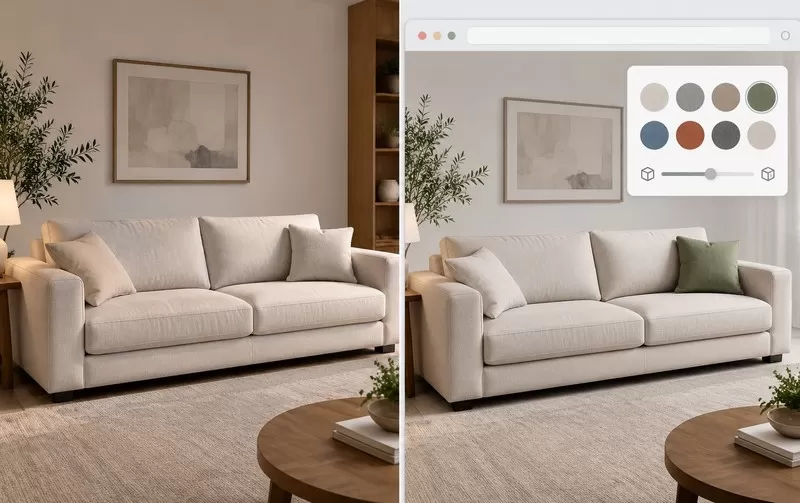
Options are where it gets expensive. One sofa line with six fabrics, four sizes and eight leg styles has 192 combinations. A client of ours once counted their actual photo coverage: 14 photos for a 192-SKU line. The remaining 178 lived in the buyer's imagination, which turned out to be a poor substitute for a decision.
Made-to-measure products leak worse. If the buyer's cabinet has to be 2,370 mm wide because their alcove is 2,400 mm, no photo shows their cabinet. The best a gallery manages is a similar one, plus hope.
Then there's the inquiry, or rather its shape. A photo page can't hold what a buyer wants, so the form arrives as "please quote model X," and your team emails back three questions. Each round costs a day or two, and in our experience some buyers go quiet somewhere in the middle of it.
What changes with a configurator
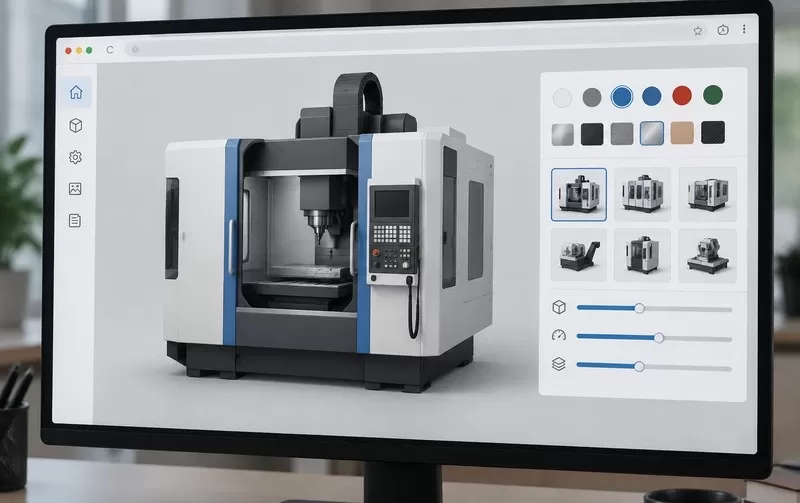
Configuration on the page changes what buyers do. Instead of scrolling a gallery and guessing, they start making choices. Fabric first, maybe. Then a width, and the cabinet redraws itself. The rules check each pick quietly in the background, so whatever they end up with is something the factory can actually make. Simple stuff technically, though the downstream effects surprise people.
One furniture client showed us their inquiry logs from before and after. Earlier inquiries read like "interested in your sofas." Afterwards they read like sofa, 240 by 95, right chaise, oatmeal bouclé, quantity two, needed by March. Their quote turnaround went from days to hours. The sales manager admitted she re-read the first few of them thinking something was broken.
There's also the boring economics. A photo shoot buys you one view of one configuration. A 3D model gets reused for every configuration of that product, and next season's colors go live the day somebody approves them, not the week after the next photoshoot gets scheduled.
The honest trade-offs
A configurator costs more upfront, and I won't pretend otherwise. A single-product build with real rules and inquiry export starts around $10,000. A photo shoot runs a few thousand. Which one looks better depends on your time horizon, and on whether customers order your product with options or custom sizes. Our services page covers how we scope and price projects if you want to model it out.
Your side of the effort is real too. Someone has to write down the option list and the compatibility rules. If the product logic currently lives in one engineer's head, it has to come out before any vendor can build with it. That homework pays off no matter what you decide about the configurator, incidentally.
And keep the photographer. Photos for lifestyle and context, 3D for configuration and detail. The strongest product pages we've seen use both.
A quick way to decide
Sit down and count the combinations. One means take better photos. A number that needs both hands means a configurator will probably pay for itself, and the sales team usually feels the difference before any report confirms it.
Start with our 3D configurator overview if this is new ground, or see how the custom furniture configurator handles made-to-measure work. Or send us your option list and we'll tell you straight whether you need one. Sometimes the answer is no, and that's a useful answer too.
FAQ
Can a configurator use photos instead of 3D models?
Some tools stitch product photos into pseudo-3D views. It looks fine for a fixed set of angles, then falls apart the moment buyers can configure options or type dimensions, because every combination would need its own photograph.
Does a 3D configurator slow the website down?
Not when it's built properly. The scene loads when the buyer interacts with it, the layout space is reserved so nothing jumps around, and the model itself is compressed to a few megabytes.
What about AR, is that better than a configurator?
Different problems, mostly. AR shows the product in the buyer's room, which is genuinely useful for fit and scale. A configurator handles options, rules and inquiry data. The stronger builds do both.