From the outside they look like the same thing. The buyer drags, the product turns, everybody's happy. I've had more than one prospect ask why they should pay configurator prices when a 360 spin "does the rotating too." It's a fair question and it deserves a better answer than a feature matrix, so here's the honest version.
A 360° spin is a sequence of photographs — often 36 to 72 frames of the product turning on a turntable. The buyer scrubs through them. What they see is real: real lighting, real material, a photograph of the actual item. Nothing about that is fake, and for certain products nothing better is needed.
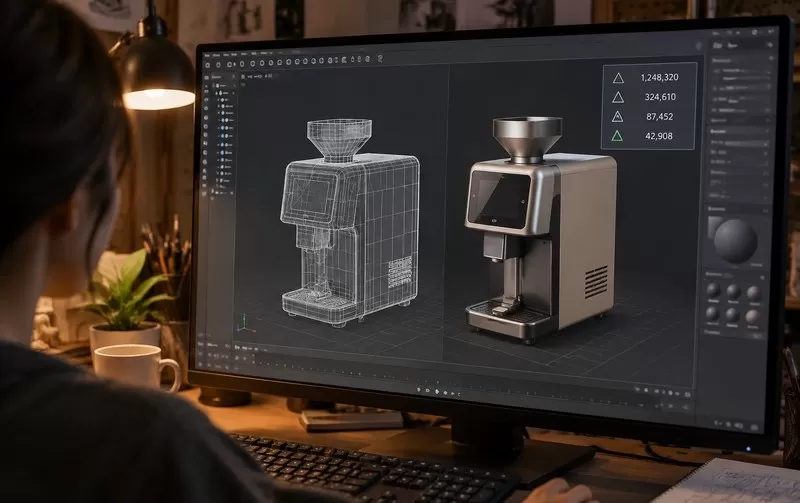
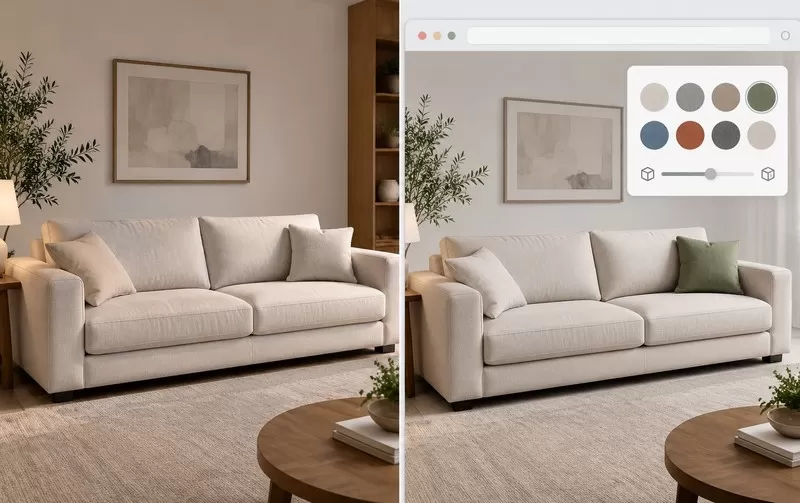
A 3D configurator is a different animal. The product exists as a real-time 3D model with materials and rules attached. Rotation is the least of what it does — the buyer can change finishes and watch them apply, add or remove components, enter dimensions and see the object rebuild, then send the exact configuration off as an inquiry or order.
The decisive test: does the buyer need to change anything
Here's the question that settles most of these decisions. Does your product come in variants that the buyer chooses between, or is it one fixed item?
If the answer is "one fixed item" — a kettle, a power tool, a completed machine you sell as-is — a 360 spin covers the need at a fraction of the cost. A turntable shoot for a single product runs a few hundred dollars, takes an afternoon, and the result loads fast and looks photoreal because it is photoreal. I will not talk you out of it, and neither should your vendor.
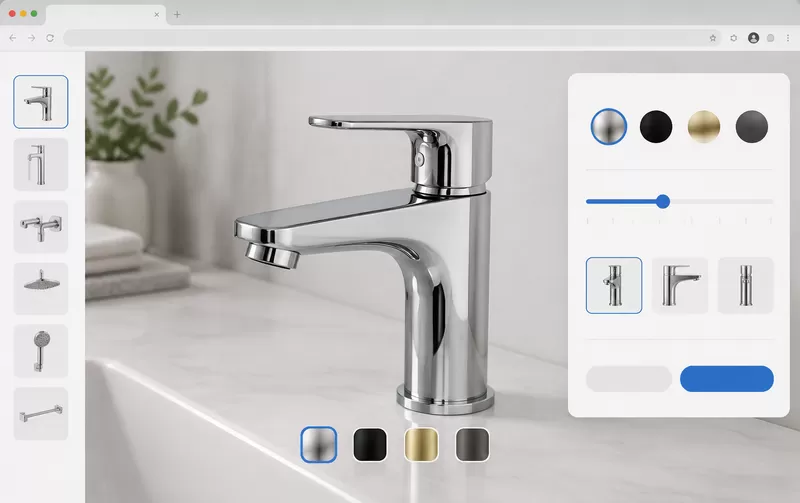
If the buyer makes choices — color, size, modules, materials — the spin starts falling apart in a specific way: every variant needs its own shoot. Twelve finishes on one faucet doesn't mean twelve spins, it can mean hundreds of frames across hundreds of product-color combinations, and a new finish next season means booking the studio again. The configurator carries variants in software. Adding a color is a material update, done in hours, at no studio cost.
Where each one wins
Spins win on realism per dollar for fixed products, and on simplicity — there's no rules logic to maintain, no model to keep in sync with the engineering files. For a catalog of stable, unchanging products, a spin library is a perfectly good investment.
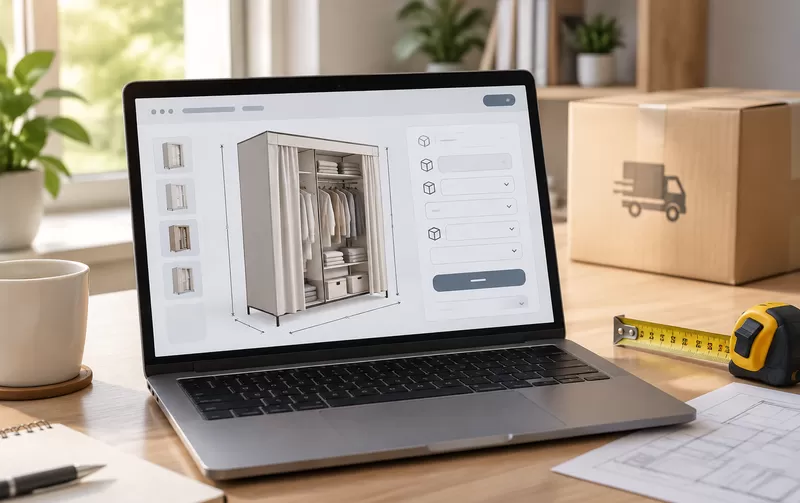
Configurators win anywhere choice is involved, and in a few places that surprise people. One is dimension: a spin can't resize. A made-to-measure wardrobe or a vehicle in a specific trim can't be shown at "your" size by any number of photographs. This is why the automotive work we do is all model-based — see our web 3D car configurator page for what that looks like in practice — because trims, wheels, colors and interiors multiply past anything a studio can shoot.
The other underrated difference is the data trail. Every choice a buyer makes in a configurator is recorded and can ride along with the inquiry. A spin is a viewing experience; it tells you nothing about what the buyer wanted. For sales teams, that difference alone often decides the build.
The cost picture, plainly
A 360 spin for one product: hundreds of dollars, days. A 3D configurator for one product family: five figures, weeks, with the second product costing much less than the first because the framework carries over. Nobody should pretend those are interchangeable prices. The configurator is an investment in how a variable product gets sold; the spin is a better photograph. Matching the tool to the actual decision your buyer makes is where the money either works or doesn't.
If your product sits somewhere in between — few variants, high value, technical buyers — it's worth a short conversation before committing either way. Describe your product range and we'll give you a straight answer, including "a spin is enough" when it is. Our 3D product configurator overview covers what a full build involves if you go that route.
FAQ
Can a 360 spin show different colors?
Only if every color was photographed. Each finish is a separate frame set, so variant-heavy products make spins expensive to build and maintain. A configurator switches colors in software on one model.
Is a 3D configurator less realistic than photos?
Web rendering has reached the point where, with proper material calibration, most buyers can't tell. Polished metals and fabrics take the most care. That said, a spin of the physical product is by definition perfectly realistic — realism isn't the configurator's selling point, variants and dimension input are.
Which one loads faster?
A spin is a sequence of JPGs and typically loads faster. A well-optimized 3D scene loads in seconds on mobile, but it does carry more data. Both are manageable with proper optimization; neither justifies a slow page.
Can we start with spins and upgrade later?
The formats don't share assets, so spins can't be converted into a configurator. If variants or customization are clearly coming, building the model path from the start avoids paying twice.
What about AR — does that change the math?
AR view-in-room works on top of a 3D model, so configurator projects can extend into AR with the same asset. A spin can't become AR. If AR is on your roadmap, that tips the decision toward the model.