The companies that call us about bathroom products rarely open with 3D. They mention a photo shoot instead. Somebody upstairs has just approved the invoice for the faucet range, three finishes across twenty-odd SKUs, every angle covered, and the studio needed most of a week to get through it. Chrome causes most of that pain. It works like a curved mirror and picks up the studio, the photographer, even the softbox, so each new angle means relighting the set. Matte black is cooperative. Brushed nickel falls somewhere between the two. And next season the range adds two finishes and the studio books again.
Then there is the way people actually buy these products, which brings its own problem, one that shows up after delivery. Bathroom products exist inside real clearances. A wall-hung basin has to account for the toilet beside it, the tile line, the way the door opens. Homeowners measure the room in centimeters and then sit with a PDF trying to match those numbers to a table. The ones who misjudge it discover the mistake on installation day, with the plumber in the hallway and the basin in the wrong place.
We had a close view of one project in exactly this category; our sanitary products case study covers a build for a bathroom products manufacturer. Between that and similar work, here's what actually matters.
What goes on screen
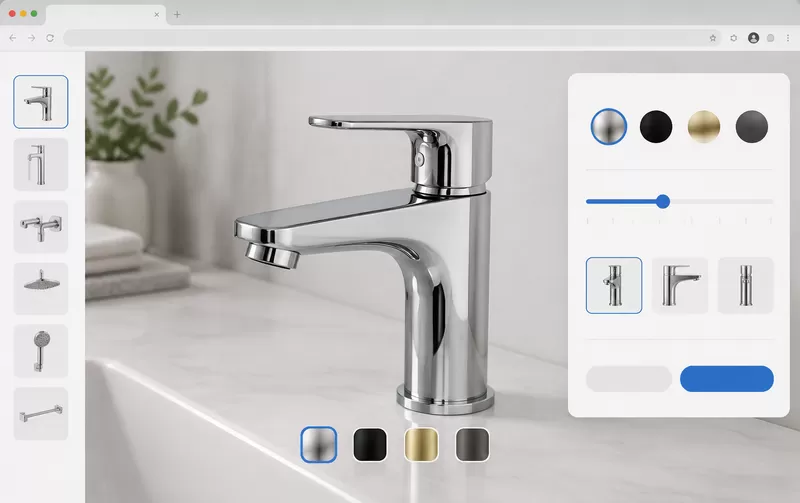
It starts with a real-time model running in the browser. Finish switching is where faucet and shower brands get the most immediate value: one model carries chrome, matte black, brushed gold, gunmetal, whatever the line includes, and adding a PVD coating later is a material update rather than a reshoot. The finish list in this industry only ever gets longer, which is precisely why photography struggles to keep pace.
Dimensions come next. Wall-hung basins and toilets can carry their measurements on the model, and where the range has size variants — a 450mm compact basin against a 600mm — the geometry rebuilds as the buyer switches. Zooming is where skeptical buyers head: the tap hole, the overflow, the mounting bracket. A spec table buries those details. The model puts them one click away.
Shower systems and vanity units add module selection on top. Rail lengths, head shapes, handhelds, storage boxes. The configurator assembles the buyer's picks and checks them against build rules, which catches the combinations that photograph nicely and then refuse to fit an actual bathroom.
What changes in the inbox
The inquiries themselves arrive assembled. Whatever finish, size and modules the buyer selected, plus any dimensions typed in, travel along with the message. A sales rep therefore starts the conversation at quoting rather than at figuring out what the buyer meant. On export orders that matters more than it might sound, because one clarifying email can cost a full day when the buyer sits eight time zones away.
Something subtler happens with buyer intent. A person who has spent two minutes rotating a faucet against their tile color tends to arrive more decided than someone who skimmed a gallery. I can't offer a universal conversion number, because traffic and product mix move it too much, but inquiry quality is the metric worth watching and it usually moves early.
The chrome problem, again
Full circle back to the photography story: chrome is also the hardest thing to render. In a browser scene, a polished surface is only as convincing as its environment map, so a large share of the material work goes into building reflections that read as metal rather than gray plastic. Matte finishes demand the opposite discipline — too much gloss and matte black starts looking like painted MDF.
Geometry is friendlier territory. A faucet compresses to a few tens of thousands of polygons without losing the parts buyers zoom into: aerators, cartridge indicators, mounting points. When those are right, the product feels right. When they're wrong, no amount of lighting saves it.
Starting from factory CAD speeds all of this up. Photos and physical samples also work — the case study mentioned above began from exactly that kind of material, and it simply takes a bit longer.
Cost, and whether you need this at all
One product family with a handful of finishes usually lands in the low five figures, and the second family costs noticeably less because the framework is already standing. Three to six weeks is a realistic window for a first build. Tell us your product range and we'll scope it properly rather than inventing a number here.
I should add that not every bathroom brand needs one of these. If the catalog holds ten fixed products in a single finish, and the buyers are trade people who have the SKUs memorized, then decent photography and a tidy PDF will do the job fine. The project starts to make sense when finishes keep multiplying, or when custom sizes join the range, or when export buyers who will never see a showroom make up most of the inquiries. Where two of those apply, the numbers usually work.
FAQ
Does the configurator show finishes accurately?
Materials are calibrated against physical samples under standard lighting, so chrome reads as chrome and matte black as matte black. Screen calibration varies, of course — we recommend a physical sample kit alongside the configurator for final color sign-off, and most of our clients do exactly that.
Can buyers check whether a basin fits their bathroom?
Yes. Dimension display is standard, and size variants rebuild the model in real time. For made-to-measure products, buyers can enter their own measurements and see the model scale accordingly.
Do we need CAD files from our factory?
It helps but it isn't required. We've built product models from photographs, physical measurements and video calls. CAD data just makes the geometry stage faster.
Does it work on phones?
Yes, and it needs to, because a large share of bathroom product browsing happens on mobile in the evening. The scene is optimized to load in seconds on a normal 4G connection.
Can it connect to our B2B ordering system?
Configuration data can be exported as structured JSON and pushed into most dealer, ERP or CRM systems. That's part of the integration work, scoped per project.