English
 繁體中文

A pendant was ordered in brushed brass, 3000K, with a 1.5-metre drop. It arrived correctly. On site, the ceiling was a concrete slab with no recess and no accessible void, so there was nowhere to fix the canopy and nothing to run the cable through. The order was right and the installation was impossible. A lighting 3D configurator exists to catch that before the crate is packed, and the option that decides it is not the finish.
Six decisions, not one
Lighting looks like a colour problem and is actually a multiplication. Each of these changes something structural about the product, not just its appearance.
| Decision | Typical range | What it actually changes |
|---|---|---|
| Fixture type | pendant, surface, wall, recessed, track | mounting prep, cable route, ceiling load |
| Size | 3–5 diameters or lengths | canopy size, weight, suspension point |
| Material and finish | 6–12 options | cost, lead time, maintenance, cleaning method |
| Colour temperature | 2700K–4000K | driver, CRI grade, dimming compatibility |
| Dimming protocol | phase, 0–10V, DALI, wireless | driver selection, wiring, control system |
| Accessories | diffuser, hood, connector, glare shield | light distribution, IP rating, noise |
Six dimensions at four to twelve options each lands in the thousands before anyone has discussed a project. That is the space a configurator has to hold.
Installation is treated as a finish, and it is not
The most expensive mistake in this category is picking mounting as though it were a surface treatment.
Recessed needs a cut-out and a void behind it. Surface needs a back box and a fixing point. Pendant needs a load-rated anchor and a drop length, plus a decision about where the excess cable goes. Track needs the track installed first, which is a separate product line and a separate lead time. Magnetic systems need a recessed profile and a driver location that is accessible for service.
None of that is visible in a render of a lit fixture against a wall. All of it decides whether the order ships twice.
A lighting fixture configurator that asks for the mounting condition early will remove options the site cannot take. Asking late turns a specification into a negotiation with the contractor.
Size is structural, not cosmetic
A 1200 mm pendant is not a scaled-up 400 mm one. The canopy has to carry more weight, the suspension needs a rated anchor rather than a plug, and the ceiling void has to take a driver that grew with the fixture. In a finished room, the maximum diameter is often set by what can be hung safely rather than by what looks right.
It cuts the other way too. A fixture over a dining table needs clearance to walk under and to see across, which removes long drops from low ceilings entirely. Height is cheap to check and expensive to discover on installation day.
Most combinations are never sold, and all of them need an image
A series with 200 SKUs is usually a handful of platforms multiplied out. In practice a small subset carries the volume, and the rest exist for the one specification that comes along twice a year.
That is also why photography stopped working. Two hundred product shots is already a budget. Two hundred shots times six finishes is not a budget, it is a studio.
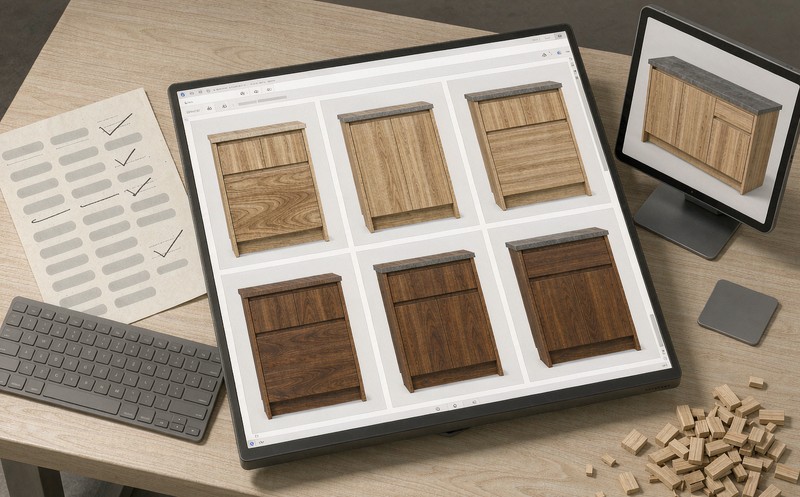
The configurable states still have to be visible, though, because the specification that arrives in March is exactly the one nobody photographed. This is where the case for a configurator gets simple: one model set, rendered across the option space, beats a photo library that covers a fraction of it.
Which is the same argument made for custom lighting fixtures and 3D configurators on the channel side. This piece is about the option structure underneath it.
Some combinations do not exist
The rule layer is where lighting gets harder than furniture. Three examples that come up constantly:
A large diameter with a small canopy is a physical problem, because the canopy has to carry the weight and the suspension points.
A dimming protocol that the chosen driver does not support is an electrical problem, and it surfaces after installation when the lights flicker at low output.
A high colour temperature with a high CRI grade may not exist in the chosen form factor at all, because the LED module that fits the housing does not come in that combination.
None of these should appear as selectable options. The mechanics of blocking rather than hiding are the same ones described in product configurator rules engine, and the lighting-specific twist is that half the blocking rules come from the driver supplier rather than from your own catalogue.
Accessories change the light, not the look
The last group is the one buyers treat as decoration and engineers treat as specification.
A diffuser softens the source and drops output by a measurable margin, which changes the number of fixtures a room needs. A hood cuts glare in one direction and creates a dark side in the other. A connector determines how many units can run on one feed before the driver has to be resized. None of these are visible as a colour, and all of them change what the room gets.
So accessories belong inside the configuration rather than as an upsell checkbox after the price. A quote that adds a diffuser to a fixture count sized without one is a quote for a different lighting scheme.
Price by configuration, quote with a date
Lighting prices move with material, driver and finish, and metal prices move on their own schedule. A configurator that produces a number without an expiry creates a dispute three months later.
The practical setup is a configuration-based price with a validity window, and a rule that says which components can be substituted without a re-quote. Without the second part, every supply hiccup turns into a sales conversation.
Metal movement is where quotes go stale. What matters for the tool is less which index it references than that the reference appears on the quote, so a customer comparing two offers can see whether the gap is design or market.
What the output has to contain
Not a picture. A specification sheet with the fixture type, the mounting method, the cut-out or anchor requirement, the drop length, the colour temperature, the CRI grade, the dimming protocol and the driver reference.
The cut-out dimension is the line that saves the most money, because it is the one the contractor needs before the ceiling is closed. The driver reference is the second, because it is what the electrician orders when the original fails in year four.
A lighting 3D configurator that outputs both is doing operational work rather than marketing work, and that is the difference between a tool the sales team uses once and one the factory asks to keep. If your range has an option space that photography cannot cover, tell us how many platforms and finishes you actually sell and we will size it from there.
FAQ
Q: Why is mounting the option that causes the most rework?
Because it is usually presented as an appearance choice while it actually depends on the building. Recessed needs a void, surface needs a fixing point, pendant needs a load-rated anchor, track needs the track installed first. A fixture that is correct in the catalogue can be uninstallable on site.
Q: How many options can a lighting configurator handle?
The limit is not the interface but the rule set. Six option groups with a handful of choices each is easy to render and hard to constrain, because the compatibility rules come from drivers, LED modules and structural limits rather than from a single product table. The work is in the rules, not the viewer.
Q: Can it handle custom sizes as well as standard ones?
Within a bounded range, yes. Parametric sizing works while the platform can scale without changing the electrical or optical design. Past that range the fixture is a different product needing an engineering check, and the tool should say so instead of stretching the model.
Q: Is a configurator cheaper than photographing every combination?
For a range with more than a few dozen states, yes by a wide margin. Photography costs scale with combinations, while a model set scales with platforms. The configurator also covers the combinations nobody has ordered yet, which is where a photo library quietly fails.