English
 繁體中文
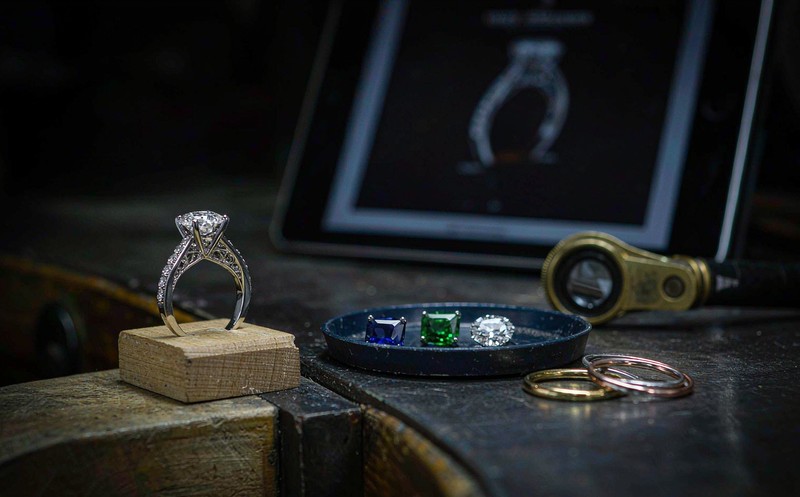
A jeweller shot four hundred ring photographs, which is a serious library for a mid-size brand. Then a customer asked to see the solitaire in rose gold with an emerald and a half-eternity band. That photograph does not exist and never will, because the combination is one of thousands and the shoot would have to be repeated for each. A jewelry 3D configurator exists because the arithmetic of photography stopped working in this category before most brands noticed.
Four decisions, multiplied
One published ring builder puts its own catalogue at roughly 28,400 combinations across four decision groups. The exact number matters less than the structure, which is the same everywhere in the trade.
| Decision group | Typical options | What it constrains |
|---|---|---|
| Stone shape | round, oval, cushion, emerald, pear, princess, marquise | which heads are available |
| Head or setting | four-prong, six-prong, bezel, halo, cathedral, three-stone | stone size range, shank clearance |
| Shank | plain, pavé, channel, twist, split, knife-edge | head height, resizing range |
| Metal | platinum, 18k yellow, white or rose, palladium | price, finish options, repair method |
Four columns, a handful of choices each, and the product line runs into five figures. Nobody photographs five figures.
The parts constrain each other, which is the actual work
Rendering is the easy half. The hard half is that a choice in one row removes choices in the others.
A pear-shaped stone will not sit in every head, because the prong positions assume symmetry the cut does not have. A wide shank raises the head, which changes how a halo sits and how the ring reads on the finger. A platinum setting behaves differently from gold during resizing, which matters for a piece that will be worn daily for forty years. And a halo in rose gold is not the same product as a halo in white, because the plating and finishing steps differ.
None of those refusals belong in a note to the customer. They belong in the tool, which is why a ring configurator is a rules problem wearing a 3D interface. The blocking mechanics are covered in product configurator rules engine, and the jewellery version adds one constraint most other categories do not have: some combinations are legal but bad, and the tool should still allow them with a warning rather than remove them.
Ring size and engraving are configuration, not remarks
Two items get lost because they are not 3D objects.
Finger size changes the metal volume, the resizing range and sometimes the shank style that is even possible. It has to travel with the order as a structured field, not as a line in an email, or the workshop calls to confirm and the schedule slips a day.
Engraving is text with a character limit that varies by font, ring width and whether the ring is comfort-fit. Customers find this out by being told after they have decided. A tool that shows the limit while they type removes a revision loop.
Only offer what the bench can make
The commercial risk in jewellery is not an ugly render. It is a configuration that gets sold and cannot be produced, or can be produced but not repaired.
Three filters do the most work here. Which heads fit which stone shapes, which is a manufacturing fact rather than a design preference. Which metals the workshop will actually work in, since palladium and platinum behave differently under the torch. And which combinations the setters refuse because the prongs would be too thin to survive wear.
Whoever owns those filters needs to be the workshop, not the marketing team. A ring configurator that lets the web team invent options will produce a catalogue the factory quietly ignores.
Stones are inventory, not a swatch list
A stone is not a colour option. Each one carries a certificate, a carat weight, a clarity grade and a price that moves with the market, and the customer is choosing a specific object rather than a category.
That changes the data problem. The configurator has to read live stock rather than a static list, because the sapphire that priced the configuration on Monday may be sold on Wednesday. When it is, the configuration stops being orderable at that price, and the buyer needs to know before paying a deposit. Tools that treat stones as fixed options produce orders for stones that left the vault last week.
Two modes, one model
Most brands need the same configurator twice: a public mode for customers working alone, and a counter mode a salesperson drives on a tablet in the showroom.
The underlying data can be identical. The guardrails cannot. Public mode has to stop a shopper from building something unmakeable, while counter mode can expose more of the range because a trained person is filtering as they go. Building one mode and presenting it as both is how a tool ends up too complicated online and too restricted at the counter.
Price moves with the metal, so quotes need a date
Gold and platinum prices move independently of the design. A configuration priced in March and ordered in June is a different number, and a configurator that hides that produces an argument.
The workable arrangement is a configuration-based price with a metal basis and an expiry, plus a rule for which substitutions can be made without a re-quote. That last part is what keeps a shortage from becoming a renegotiation.
Lead time is part of the configuration
A ring that needs a halo built around a specific stone takes longer than a solitaire in stock metal, and the gap is measured in weeks. If the tool does not show it, the customer picks the more complex design and learns the date afterwards.
An indicative lead time per configuration costs little to add and prevents the most common post-order complaint in the category.
What the output has to be
A specification sheet with the four decisions named, the stone dimensions, the ring size, the engraving text and font, the metal and its finish, and the setting reference.
After that comes a workshop ticket the bench can read without opening the configurator. If those two documents disagree, the order goes wrong regardless of how good the 3D looked.
Where the piece is visualised before purchase, the presentation matters more than in most categories, and the trade-offs between formats are the ones set out in interactive 3D product display. But the visual is the shop window.
A jewelry 3D configurator is worth building because it holds 28,000 theoretical combinations down to the few hundred the workshop can actually deliver, and by making that boundary visible while the customer is still deciding. If your range has more combinations than your photo library will ever cover, tell us how the pieces are assembled and we will start from the parts list.
FAQ
Q: Is a jewelry 3D configurator only for engagement rings?
No, though rings are where it started because the combination count is highest and the purchase is highest-stakes. Pendants, earrings and bracelets use the same structure with fewer decision groups. The test is whether the option space exceeds what photography can cover.
Q: Why can't the tool simply allow every combination?
Because some combinations cannot be manufactured and others cannot be repaired. Prong positions depend on stone shape, shank width changes head height, and not every workshop works in every metal. A tool that shows everything produces orders the bench rejects.
Q: How does engraving work in a configurator?
As text with constraints. Character limits vary by font, ring width and fit, and the customer should see the limit while typing rather than after ordering. The approved text travels with the order as a structured field so the workshop does not re-enter it.
Q: Does real-time pricing work when metal prices move?
Yes, with a metal basis and an expiry. The configuration price is calculated from a reference metal rate, and the quote carries a validity window. Substitution rules then decide which component changes require a new quote and which do not.