English
 繁体中文
繁体中文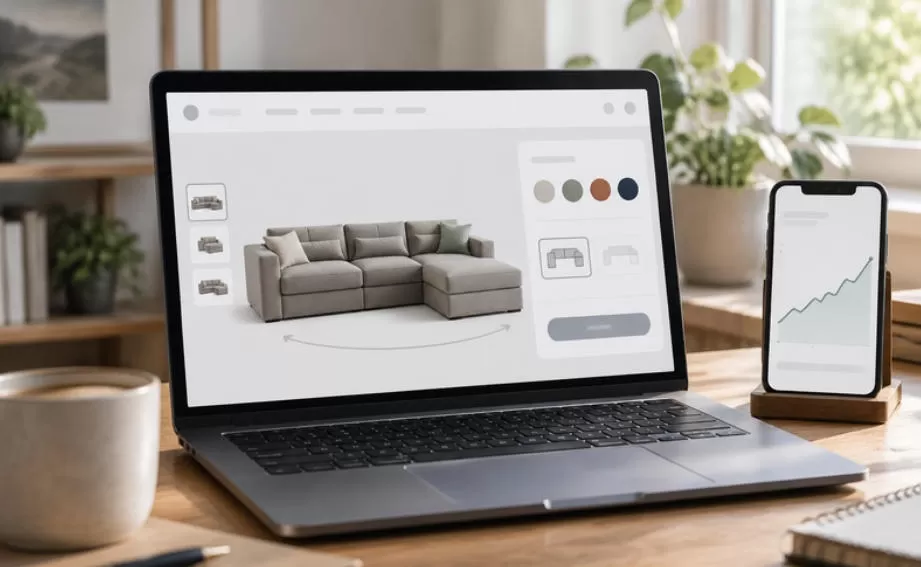
Short answer first: on products where buyers hesitate over how something will look or fit, a configurator changes conversion by amounts that published studies put anywhere from 25 to 94 percent, and the spread in those numbers is itself worth understanding. We build configurators for a living at Took3D, so treat that as a disclosed interest. What follows is the data with its sources, the psychology behind the numbers, and the situations where I would tell you not to bother.
What the published numbers actually say
Shopify's merchant data, the most quoted figure in this space, puts conversion 94% higher on products with 3D content than on the same products shown with static images. It gets cited everywhere, usually without the caveat that it is a merchant-reported average across self-selected stores rather than a controlled experiment. Read it as a ceiling rather than a promise. Threekit, another vendor, reports an average lift of 40%, along with the claim that shoppers who interact with a 3D view are eleven times more likely to buy than those who only see photos. Part of that gap selects for intent rather than creating it, since a shopper who plays with a configurator was already more serious, but even discounted the direction is consistent.
Return rates are the cleaner story, because the mechanism there is physical rather than statistical. Furniture and apparel brands using 3D visualization report reductions of 25 to 40 percent, which lines up with the main reason online returns happen at all: what arrived looked different from what the buyer had imagined. Average order value moves too, typically 20 to 35 percent upward, and Bain's research on customization found that customers will pay roughly a 20% premium for a product they helped configure. Audi's real-time configurator pilot lifted engagement by 66% and, more tellingly for revenue, increased the number of paid options selected per vehicle by 9%.
A realistic planning assumption for a well-built configurator on a suitable catalog: conversion up 30 to 40 percent, returns down a quarter to a third, order value up around 20%. Results better than that usually reflect strong baseline traffic or a category where doubt is unusually expensive. Results worse than that usually point to an execution problem, which the sections below should help you avoid.
Why it works: three mechanisms with research behind them
Doubt is the core problem a configurator solves. A shopper looking at photos of a modular shelf has to imagine how the oak veneer sits against the walnut panel, whether 180 centimeters will swallow the wall, what the corner joint looks like up close. Every unresolved question makes the tab closing a little more likely, and almost none of them get asked, because none feels important enough to email support about. A configurator answers them the moment they occur, by letting the shopper apply materials and see the result rendered in real time. No photo gallery has ever managed that, which is why the conversion gap between the two formats shows up consistently in study after study.
The second mechanism has a name in the behavioral research, the endowment effect. Someone who has spent four minutes arranging modules has, in a psychological sense that no marketing copy can fake, already furnished their wall. This is where Bain's 20% premium finding comes from: people pay more for things they feel they created. In practice we watch the same behavior show up as saved configurations and screenshots sent to a partner for a second opinion, and a buyer who sends that screenshot has usually stopped comparison shopping whether or not the analytics notice.
Visible upselling is the mechanism that surprises clients in the revenue data. A dropdown that says Premium Leather +$140 convinces almost nobody. The same leather rendered on the exact sofa the shopper configured, updating as they watch, converts differently, because the shopper can see what the extra money buys. Those 20 to 35 percent order value increases mostly come from this one behavior, and it is the line item most brands underestimate before launch.
Showing the running price belongs here as well, although clients argue with me about it. Several wanted the total hidden behind the inquiry form, on the theory that a visible accumulating price invites sticker shock. What happens instead is that a buyer who watches the number update with each choice stops experiencing the final quote as an ambush, and the people who would balk anyway get it over with before a sales rep has sunk an hour into the account.
Where a configurator is not worth the money
Honesty here matters more than persuasion, because a configurator on the wrong catalog underperforms a good product page. The pattern across deployments is fairly clear:
Your situation | Worth it? |
Product is customisable (colors, materials, modules, sizes) | Yes |
More variants than photography can cover economically | Yes |
High unit price, so doubt is expensive | Yes |
Bulky or spatial product (sofas, machines, cabinets) | Yes, add AR for room fit |
Two or three variants, cheap, bought on impulse | No, invest in better photos |
Single SKU with no options | No |
The honest test is whether the doubt a configurator removes costs you more than the configurator does. On a bespoke sofa or a production machine, doubt is enormously expensive and the answer is obvious. On a plain mug it is not, and a vendor who tells you otherwise is selling.
What changes in B2B
None of the retail logic transfers cleanly to B2B, where a procurement engineer does not add a production machine to a cart and the sale closes over weeks through a quotation loop. What the configurator shifts is the quality of the inquiry and the speed of that loop. An inquiry arriving with its own specification attached lets the first conversation with sales start from a concrete build rather than an open-ended discovery call, and quotes go out faster because the back-and-forth over what the customer meant shrinks. B2B teams using configured inquiries report lead-to-opportunity conversion two to three times higher than standard contact forms, which makes sense given that the specification arrives pre-built.
The dealer angle surprised me the first time I heard it. Manufacturers selling through dealer networks told us the fastest adoption came from the dealers themselves, who quoted builds on the spot during showroom visits instead of waiting for head office to price them. That conversion happens face to face, weeks before any order form appears in anyone's system.
How to measure it without fooling yourself
The vanity numbers all move in your favor for boring reasons, so discipline matters. Sessions go up and time on page goes up, and neither tells you much, since exploring a configurator is slower than scrolling a gallery by design. Watch the interval from first product view to inquiry, and configurator-to-inquiry conversion measured against regular gallery pages for the same products. Revenue per session only becomes readable once enough volume accumulates. Let a full quarter pass before concluding anything, because the first two weeks mostly show existing customers playing with the new toy.
Loading speed can quietly erase the gains. A configurator that takes eight seconds to initialize on a phone damages conversion no matter how good the experience is afterward, because most mobile buyers never get that far. We hold our scenes to a first meaningful load under 2.5 seconds on mid-range devices, the same bar we would set for a hero image, and getting there takes real work on polygon budgets and texture pipelines. That part of a project never looks impressive in a portfolio, and it frequently decides whether the whole thing works.
If you sell through Shopify, the practical side of putting a configurator on product pages is covered in our Shopify integration guide. And if you would rather have someone look at whether your catalog fits the table above, you can send us your product range and we will tell you when we think the answer is no.
FAQ
How much can a 3D configurator improve conversion rate?
Published figures range from 25% to 94%, with the 94% being Shopify's self-reported merchant average and best treated as a ceiling. A realistic planning number for a well-built configurator on a suitable catalog is 30 to 40 percent, alongside a 25 to 40 percent reduction in returns.
Which products benefit most from a configurator?
Customisable products with many variants and high unit prices: furniture, industrial equipment, vehicles, made-to-order goods. Simple products with two or three variants and low prices usually see better returns from improved photography instead.
Do we need to show prices in the configurator?
We recommend it for e-commerce. A buyer who watches the running price update with each choice treats the final quote as expected rather than as an ambush. Hiding the price until inquiry recreates the uncertainty the configurator exists to remove.
What about page speed on mobile?
It has to be engineered in. A properly optimized scene loads in a few seconds on mid-range phones. Treat load time as a requirement in the contract, because a slow configurator can cost conversions instead of adding them.