English
 繁體中文
The methods that work on furniture and industrial equipment travel well, right up to the moment you point them at a boat. Then something gives. A boat configurator looks like the same job from a screenshot, and almost nothing about the build is the same underneath.
We have not built one for a yard. What follows is where we would expect the usual approach to hit a wall first, based on work on vehicles and furniture and on what those two have in common.
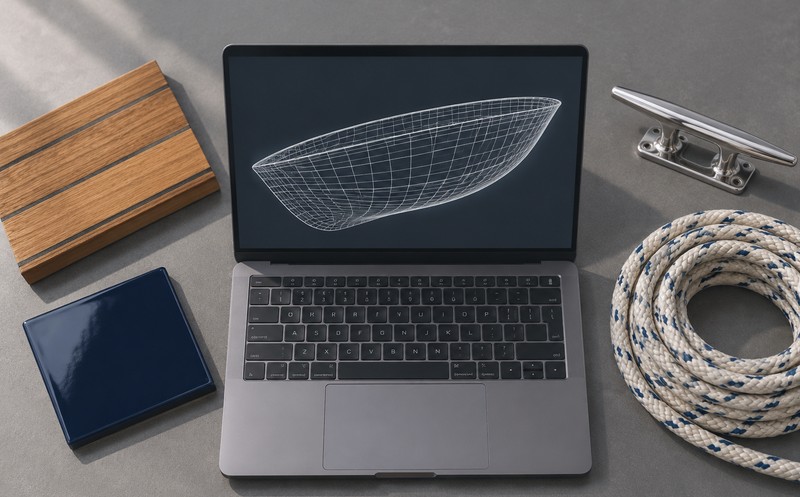
A hull is one surface, not a stack of panels
Furniture configurators work because the product is made of standard parts. A cabinet run grows by modules of a fixed width. A sofa is a base plus arms plus cushions, and each of those is a swappable block. Parameterise the block sizes and you are most of the way home.
A hull refuses that model, and this is the first place an experienced yacht configurator team stops borrowing from furniture. It is a continuous surface, a set of curves that have to stay fair as they move, and every dimension is related to the ones beside it. Lengthen the boat by a metre and the waterline changes, which changes displacement, which changes how the hull sits, which moves the interior floor and every cabinet that sits on it.
There is no equivalent of adding one more 600mm module. Somebody has to re-cut the hull.
This is why yards model a range of hulls rather than a hull with a length slider, and why a configurator for boats tends to start from a small number of base hulls and vary the things above the deck. That constraint looks like a limitation. Yards live with it because it matches how they already build.
The cabin is a space, not a picture
Below deck, the product stops being a surface and becomes a volume. Moving a bulkhead is not a layer swap. It changes where the wiring runs, where the air conditioning ducts end up, which fuel tank fits, and how somebody gets to the seacock in an emergency.
A furniture configurator can ignore almost all of this, because a wardrobe against a wall has no systems behind it. A cabin has systems in every direction, and buyers notice when the layout they chose on screen turns out to have a step where they expected a flat floor.
What this means technically is collision awareness, and a display that shows the consequence rather than silently blocking a choice. If a layout option is unavailable because of a tank, the buyer needs to see the tank. Otherwise the greyed-out button gets read as a bug and somebody calls the dealer.
Options that talk to each other across systems
The hardest part of boat configuration is not the number of options. It is how far an option reaches.
Pick a larger engine and the shaft, gearbox, engine bed and propeller pitch all change with it, the hull sits deeper, and the deck load allowance moves. A davit specified for the tender may no longer clear the hardtop. None of those are separate questions with separate answers, and a configurator that treats them as independent dropdowns will produce combinations the yard cannot build.
The structure that handles this is a constraint graph rather than a form. Options are nodes, compatibility and implication are edges, and price is a function computed over the result rather than a lookup. Building that graph is the actual design work. The model is what makes it legible to somebody who does not think in graphs.
Eighteen months sit between the click and the keys
Most product configurators end at a cart. A boat configurator ends at a conversation, and the conversation starts long after the configuration.
Delivery runs from roughly a year for a series-built RIB to several years for a custom superyacht. Nobody configures a boat and checks out. They configure, save, share the link with a partner, revisit it in three weeks after a boat show, ask a dealer to re-price it, and eventually sign something where the configuration becomes an annex to a contract.
That changes what the tool has to do. A saved configuration needs to survive a price change and show what moved. It also needs a dealer-facing view carrying the dealer's own margin, separate from what the yard quotes directly, plus an export a contract can reference. A configurator judged on cart conversions will look like a failure here, which is why the metric has to be chosen before the build. The checks worth running on a live build apply, but the conversion signal has to be defined differently.
What this does to the model budget
Boat geometry is heavier than most. There is no single building block to optimise once and reuse. Curved surfaces are harder to decimate without visible faceting, and the places where faceting shows most are exactly the places buyers look at, which are the hull sides in raking light and the interior joinery edges.
Material work multiplies too. Gelcoat, teak decking, upholstery, and stainless each behave differently under light, and the same asset has to hold up in a showroom environment and against a grey sky. This is the same problem that shows up when a configurator has to render surfaces convincingly in a car, only with more square metres of surface to cover.
The environment is a fourth burden, and it is the one furniture work never has to carry. A sofa is rendered in a room where the light is controlled. A boat is judged on water, under a sky that changes, with the hull picking up reflection from the surface beside it. Buyers are looking for one thing in particular, which is whether the boat looks like a real boat in that setting or like a model floating over a photograph. Getting there means working with environment lighting and reflections rather than a single studio setup, and it is also why putting a product into the buyer's own environment matters less here than getting the water right.
Price structure is the other thing that does not port. Furniture configurators add up base price and option prices. Boats are often sold in packages where the second and third options cost far less than the first, and the yard's number is not the number the dealer shows. Add regional duties and certification costs and a naive price engine produces figures that get corrected by hand at the worst possible moment, which is in front of the buyer.
Questions worth asking a vendor
If a studio says they have done boats, the useful follow-ups get specific. Ask what happens to a live configuration when the hull changes inside an existing range. Whether collision checks run below deck, or the layouts come from templates somebody approved years ago. And who signs off a constraint that depends on a supplier's component, given that the supplier will revise that component without telling anyone.
The answers tell you whether you are talking to a team that has shipped or a team that has rendered. A yard's configuration logic lives partly outside the yard, in engine suppliers and equipment makers, and a tool that does not plan for that will be out of date before the first boat floats.
The honest position
A boat configurator is worth building when a yard sells a range with meaningful variation and loses time to repeated manual re-specification. It is a poor investment when the range is three models and the options are finishes, because that is a photography job.
The middle case is where most yards sit, and the decision comes down to one number: how many hours a month go into re-issuing specifications because a customer changed something. If that number is high and rising, a boat configurator pays for itself in a season. If it is low, the boats are not the problem. Tell us the range and we will tell you which side of that line you are on.
FAQ
Q: Can a boat configurator handle a fully custom yacht?
Not in the sense of generating a new design. What it can do is let a buyer start from the closest existing configuration, change what is changeable, and give the yard a structured brief instead of an email thread. The engineering work still happens, but it starts from a valid base rather than a blank page.
Q: Do we need separate models for every layout option?
Usually not. Layouts can be assembled from modular interior components placed on a base hull, as long as the placement logic knows the collision rules. The models that do multiply are the ones where a change alters the hull or the deck structure itself.
Q: How long does a boat configurator take to build?
Longer than the furniture equivalent, and the extra time is mostly not code. Hull and deck geometry preparation, interior modularisation, and the constraint work around systems take the bulk of it. A single-range series boat is a different project from a semi-custom line, by a wide margin.
Q: Should the configurator live on the yard's site or the dealer's?
Both, and that is a decision worth making early rather than retrofitting. Yards usually need the public version for brand and lead capture, dealers need an embedded version with their own pricing, and the same configuration has to survive the handoff between them.