English
 繁體中文
Picture the expensive version of this failure. A sofa comes back on a pallet two weeks after delivery, because it would not clear the hallway. The page said 218 centimetres, the hallway measured 221, and the buyer had checked that hallway twice with a tape measure before ordering. Nobody in that transaction lied. A model drifted somewhere between a CAD file and a browser, and a furniture 3D viewer turned a plausible number into a confident mistake.
Furniture shopping is measurement shopping. People photograph skirting boards. They argue with partners about doorways. Whatever the page states as a dimension becomes the fact they act on, so accuracy is the product here and rendering quality is only the packaging.
What furniture 3D viewer accuracy actually covers
It is not one property. A model can be honest in one sense and lie in another, and the lies do not announce themselves.
Units give themselves away first, usually. Import a file authored in millimetres as metres and you get a wardrobe two hundred times too tall, which anyone spots immediately. The version that actually ships is quieter: the model is off by fifteen percent, roughly the tolerance nobody rechecks on upholstery, and it looks entirely convincing because nothing beside it on screen has a known size.
Silhouette matters next, and this one is where optimization does its damage. Furniture gets decimated for the web. Decimation is not neutral, whatever the export settings suggest. It rounds the sharp corner of a table, flattens the curve of a shell chair, and eats the centimetres that decide whether a chair tucks under a table. That is 3D furniture model scale losing touch with reality one polygon at a time, and the viewer keeps presenting the result as fact.
Placement is quieter still, and it hides longest. Put the pivot at the centre of a model instead of its base, and a floor placement leaves the piece hovering ten centimetres above the carpet or half sunk into it. Nobody files a complaint about that. They close the tab.
Where 3D furniture model scale drifts
Different tools carry different unit conventions, and converters fix nothing unless someone decides they should. A file can be technically correct and visually absurd at the same time, and the fix takes five minutes at import. Finding it after launch takes a week.
Scans drift differently. Photogrammetry and phone scanners capture the upholstery surface of a soft chair rather well, and thin legs, hard edges and repeated geometry rather badly. What comes out is a copy of one physical item, not a model of your specification, so it goes wrong the first time production changes a cushion depth by two centimetres.
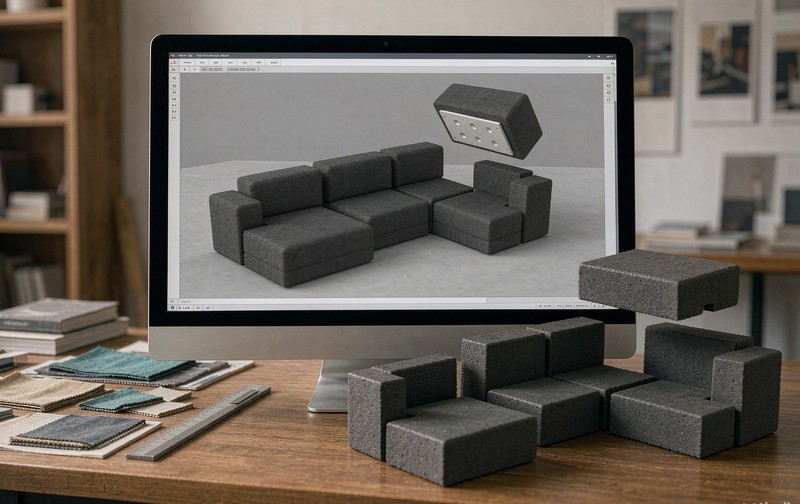
Assembly adds a drift of its own that few teams budget for. A modular sofa is not one object; it is a set of modules that have to meet cleanly when a customer joins them. Model each module in isolation and the gaps appear on the page, exactly where the customer is deciding whether the thing looks well made.
How to verify furniture 3D display dimensions before launch
The work is arithmetic and it is tedious, which is probably why so few stores do it.
Someone takes the published width, depth and height of five representative products and measures the model's bounding box in the 3D tool. A couple of centimetres of tolerance is normal on upholstery; anything wider means the model is wrong rather than the spec sheet. Five products is enough to reveal a systemic problem, because a units or origin error shows up in all five at once.
Average accuracy flatters you. The number that decides whether a buyer trusts the catalog is the tightest fit in the range, so run the comparison on the largest piece and the narrowest gap in a real room, a wardrobe against a skirting board, a dining table between two radiators. If the factory keeps a cut sheet, put the model beside it and check that both describe the same object; the same discipline is what we apply when preparing models for kitchen cabinet 3D configurator work, where millimetres turn into money quickly.
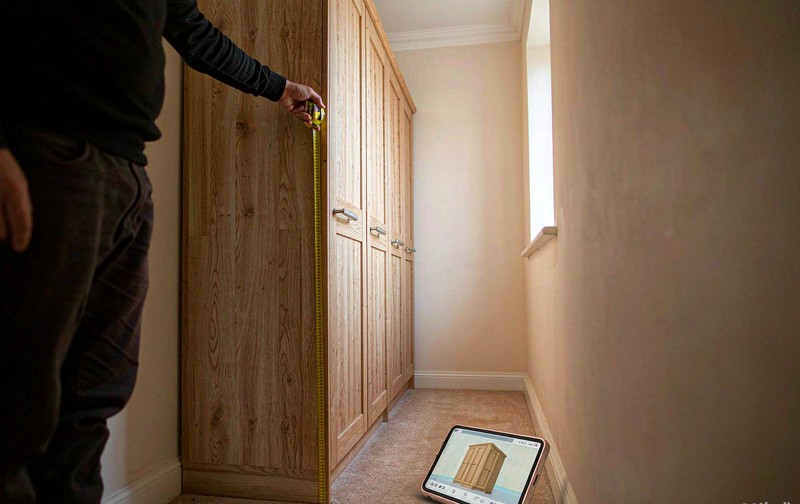
One test costs nothing and catches what spreadsheets miss. Photograph the real piece with a tape measure in frame, open the model in AR at true scale on an ordinary phone, and compare the two on the same screen. Origin and scale errors become obvious in about ten seconds, and yes, somebody has to walk to the sample room with a phone, which is the entire reason this test gets skipped.
Why dimension errors hurt furniture more than other categories
A lamp model that is five percent off costs a little credibility. A wardrobe model that is five percent off costs a return, and furniture returns are brutal in a way that small parcels are not: the item is large, the freight runs both ways, and a disassembled wardrobe almost never goes back into the box it arrived in.
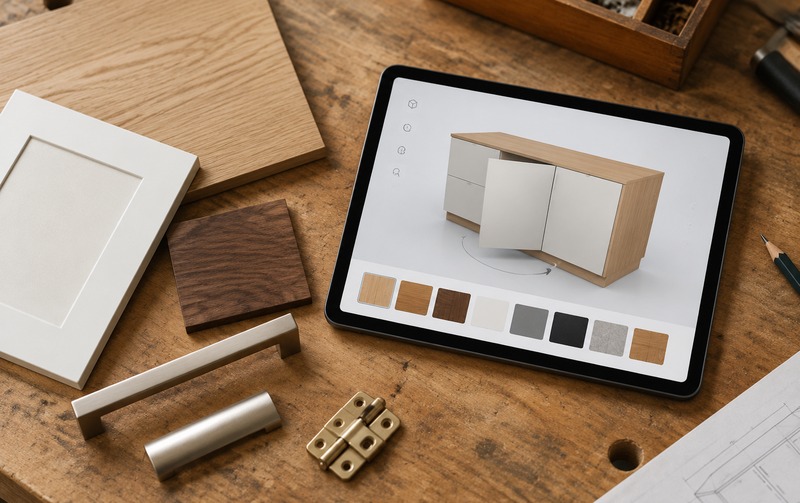
There is a second cost that never reaches the returns report. Furniture shoppers filter by dimension and plan rooms before they ever open a product image, so a catalog whose numbers cannot be trusted gets quietly excluded from consideration. What the interface does with those numbers matters too, a width readout next to the viewer, a scale reference, an overlay that shows depth; that is a display decision as much as a data one, and interactive 3D product display covers how the formats differ.
Accuracy compounds, in other words. One bad model teaches a customer to distrust the whole catalog, and that lesson is much cheaper to prevent in the asset pipeline than to repair in a support inbox.
What to ask about measurement handling
A demo tells you almost nothing here, because a demo runs on the vendor's best model. Their answer to a direct question tells you more.
What separates a studio that ships furniture from one that ships beautiful renders usually comes down to who checks bounding boxes against the spec sheet, and whether anything gets signed off on scale and origin before a model reaches a product page. The same conversation should reach whether modules within a range sit on a shared grid, since that is what keeps combinations aligned years later. It should also reach device testing, because a studio's newest phone hides precisely the problems a customer's mid-range Android reveals.
Platforms built for catalog-scale furniture viewers tend to automate that checking across thousands of SKUs, while bespoke studios tend to own each model by hand and charge for the attention. Neither shape is wrong; the trade-offs are the ones set out in furniture configurator software, and they apply to a plain viewer project too.
Glamorous it is not. Getting it right is still the difference between a furniture 3D viewer that sells furniture and one that generates support tickets, and the gap between those two outcomes is measured in centimetres. If a build is on your roadmap and you want the model pipeline examined before anyone signs, tell us about your range and we will run the checks alongside your team.
FAQ
Q: What does dimensionally accurate mean for a furniture 3D viewer?
Real-world scale, a silhouette that still matches the piece after optimization, and a pivot at the base so the model sits on a floor. Miss any one and the viewer misleads buyers while looking perfectly fine to whoever approved it.
Q: Can I use a phone scan to build furniture 3D models?
For soft, simple shapes sometimes, though what you get is a copy of one physical item rather than a model of your specification. Thin legs, hard edges and repeated geometry come out poorly, so anything with tight tolerances is better modelled from CAD or measured drawings.
Q: How do I check model sizes before launch?
Compare bounding boxes against your spec sheet for five products, run the comparison on your tightest real-world fit rather than an average, and do one AR placement test on a mid-range phone with the physical piece beside it and a tape measure in the frame.