English
 繁體中文
A furniture configurator for one category goes live after six months of work. It holds, the sales team uses it, and the first quote that comes out of it matches what the costing sheet says. At that point someone in the room says the obvious thing: the shoe cabinet is basically the same box, so the next one should take a month.
It takes four, and the tool that comes out the other end shares less with the first than anyone expected.
Some things really do transfer, and it is worth naming them
The material library carries over completely. Board decors, door fronts, edge banding, hardware ranges, finish codes. This is usually the single largest asset a furniture maker builds, and it is built once.
The pricing engine's skeleton transfers too, meaning the part that turns a selection into a number. What does not transfer is the formula inside it, but the machinery around the formula is reusable.
The interface conventions transfer too, in a way that is easy to overlook. Whatever the first category taught about how many options fit on one screen, how a module should be labelled, where the price belongs, carries straight across. That is roughly a week of argument saved per category, which is not nothing when the fourth one starts.
The rendering pipeline transfers. The same asset budget, the same lighting setup, the same texture compression rules, and the same limits on what a browser can make convincing. If the first category was solved with discipline, the second inherits that discipline for free.
The box looks identical and behaves nothing like the last one
This is where the month estimate dies. A wardrobe and a shoe cabinet are both rectangular carcasses with doors, and that is roughly where the resemblance stops.
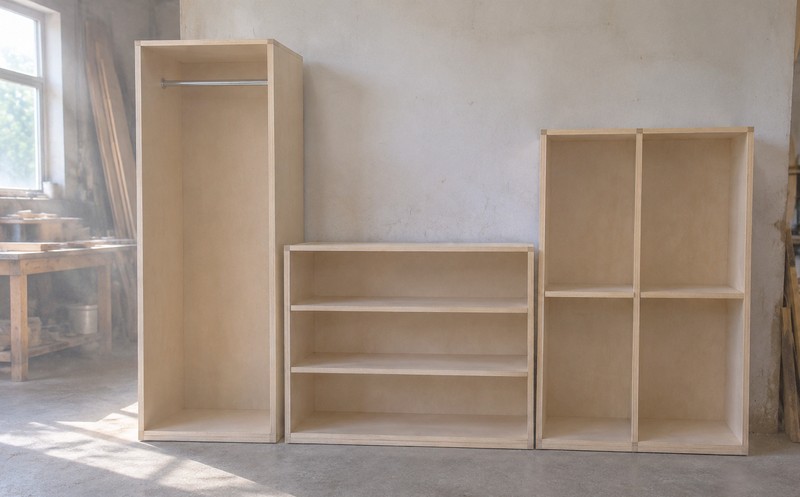
A wardrobe's interior is organised by hanging height. A shoe cabinet's is organised by shelf pitch, because shoes come in heights from a flat sandal to a boot, and the shelf spacing that serves one fails the other. The modules are not the same shapes with different labels, and the dimension accuracy that makes a wardrobe believable does not automatically carry into a form where the shelf pitch is the whole point. They are different objects with different limits.
Then come the rules that only exist in one category. A bookcase has a maximum shelf span before the board sags, and that span changes with board thickness and with what is being stored. A TV unit needs cable outlets in the back panel, which means the back panel is no longer a single flat part. A desk needs a cable channel, and if it is a sit-stand desk the whole structure has a travel range. None of these constraints appear in a wardrobe, and none of them can be inferred from the model.
A window seat is the clearest case. Its depth is set by the window sill, its width by the wall, and its top has to be cut around whatever the wall does at that height. It is the same material and the same door hardware as the wardrobe, arranged under a completely different set of constraints.
Rules live per category, and nobody warns you about it
The first category teaches a team to think in terms of options and dependencies. The second teaches them that the dependency graph itself is category-specific.
In a wardrobe, the dependency that matters most is between width and door count. In a shoe cabinet, it is between shelf pitch and total height, because the number of usable shelves is what the buyer is really choosing. In a bed with storage, it is between the lift mechanism and the mattress weight, which is a rule about physics rather than appearance.
Kitchen projects tend to hit this first, because their runs are longer and their production handoff is harder. A custom furniture configurator built as one big rule set covering every category becomes unmaintainable within a year. What works is a shared engine with per-category rule modules, so that adding a category means adding rules rather than editing everything.
The cost curve bends twice
The first category is the most expensive because the toolchain does not exist yet. Modelling standards, material library, rendering setup, the interface conventions buyers will actually use. All of it gets invented.
The second one feels cheaper because the toolchain is there, and then surprises everyone by coming in at roughly half to two thirds of the first. Geometry is new, rules are new, and testing takes as long as it did the first time. Only the scaffolding is reused.
Categories three and four drop again, because a pattern emerges in how the geometry is parameterised and how rules are written. A team that has done three can usually estimate the fourth within a reasonable margin.
Testing does not carry over at all. Every category needs its own acceptance round with real salespeople entering real orders, and the failure modes are different each time. A wardrobe test surfaces door-gap problems. A shoe cabinet test surfaces shelf-pitch problems. The same four weeks get spent twice, and there is no shortcut that does not cost more later.
Then the curve turns back up, and it does so for a reason that has nothing to do with software. Once a furniture maker has six or seven categories live, customers start asking for combinations that cross them. A wardrobe that meets a desk at a corner. A window seat that turns into a bookcase. A bed with a headboard that matches the adjacent wardrobe run. This is also where modular systems get interesting, because a combination the software treats as two products is one purchase decision for the buyer. Each of those is a new kind of problem, and none of them was in the original scope.
Which three to build first
The instinct is to start with the flagship product, which is usually the one with the highest margin. That is often the wrong first choice, because flagship products tend to be the most customised and the least rule-friendly.
The comparison criteria that matter when picking software are not the same ones that decide the build order, which is why teams often get this backwards. A more useful pair of filters here is order volume, and how settled the rules are. A category with hundreds of orders a year and rules that have not changed in eighteen months will produce a configurator that gets used. A category with forty orders a year and a design that shifts every season will produce something that is out of date before it ships.
In most ranges that points at the same few categories: wardrobes, shoe cabinets, TV units, sideboards. High volume, well-understood interiors, rules that the workshop has been applying the same way for years.
Window seats, bunk beds and anything with curved or irregular geometry are better second-year projects. Their rules are either site-dependent or safety-dependent, and both take longer to pin down than a buyer expects.
The question to ask before committing to a range
Not how many categories can be built, but which three will pay for the toolchain. The rest can follow on a schedule that reflects the real shape of the curve rather than a straight line drawn in a proposal.
A furniture configurator that covers one category well is worth more than five that each work halfway, because the first one changes how the sales team operates and the others only change what the website lists. Send us the category list and the order volume behind each and we will tell you which three to start with, and roughly what the fourth will cost once the pattern is set.
FAQ
Q: Can we reuse the 3D models between categories?
Panels, doors and hardware, yes. Assembled modules, rarely. A wardrobe carcass and a shoe cabinet carcass may both be 18mm board, but the internal drilling, the shelf positions and the back panel treatment differ, and rebuilding from shared parts is usually faster than adapting a finished model.
Q: Is it better to build one deep configurator or several shallow ones?
One deep. A configurator that handles one category properly gets used daily and generates reliable data. Several shallow ones sit unused, and the sales team goes back to quoting by hand within a quarter.
Q: How long does a second category take compared with the first?
Somewhere between half and two thirds of the first, if the first was built with reuse in mind. If it was built as a one-off, the second can cost as much as the first, because the parts that should have been shared are embedded in the first category's logic.
Q: Do we need the same level of visual quality for a shoe cabinet as for a wardrobe?
Usually not. The wardrobe is the piece a buyer studies, because it is expensive and it fills a wall. A shoe cabinet in the same range is judged faster. Spending the same asset budget on both wastes money that the fourth category will need.